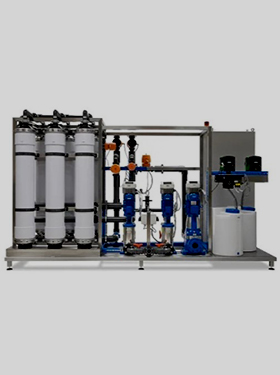
Ultra-filtration Plant
ULTRAFILTRATION PLANT
Ultrafiltration (UF) is a water purification process in which water is forced through a semipermeable membrane. Suspended solids and high-molecular-weight solutes remain on one side of the membrane, the retentate side, while water and low-molecular-weight solutes filter through the membrane to the permeate side. UF can remove most organic molecules and viruses, as well as a range of salts.
It has gained popularity because it produces a stable water quality no matter the source water, has a compact physical footprint, removes 90–100% of pathogens, and does not require chemicals, except for cleaning membranes.
Working Principle:
In UF, water is passed under pressure through hollow fiber membranes. Larger particles like suspended solids, pathogens, and organics are retained, while purified water passes through the membrane, delivering consistent quality without the need for chemicals.
Key Features:
Removes up to 90–100% of bacteria, viruses & colloids
No chemical usage during operation (chemical-free)
Compact footprint and easy integration with existing systems
Robust membrane life and minimal maintenance
Available in skid-mounted or containerized units
Flow rates available from 100 LPH to 20,000+ LPH
Advantages:
✅ Stable output regardless of source water
✅ Environment-friendly – no harmful waste
✅ Cost-effective pre-treatment for RO systems
✅ Simple cleaning and backwash process
✅ Ideal for water recycling and reuse applications
Applications:
🏭 Industrial Water Treatment
🏢 Commercial Buildings
🏥 Hospitals & Labs
🚰 Drinking Water Systems
🌿 Effluent & Sewage Treatment Plants (ETP/STP)